
Whitepaper
5 min Read
28 Sep, 2026
Share On



This Whitepaper, part of our Private Equity series, examines why purchase price discipline now separates winning private equity funds from the rest. Between 2010 and 2017, buyers who paid the cheapest prices earned 2.8x their invested capital, barely ahead of the 2.7x earned by the most expensive buyers. In the 2018–2023 vintage, that gap widened to 3.4x versus 2.7x. Yet average buyout entry multiples still reached a record 11.8x EBITDA in 2025, and 18.1x for larger deals. The tension is clear: the evidence favors discipline, but market behavior does not, and that mismatch shapes which managers deliver returns from here.
For over a decade, a rising market let private equity firms overpay without consequence. Between 2010 and 2017, cheap and expensive buyers delivered nearly identical returns. That has changed. In the 2018–2023 vintage, disciplined buyers earned 3.4x their invested capital versus 2.7x for overpayers, and top-performing disciplined funds reached 5.5x versus 3.6x.
Yet entry multiples hit a record 11.8x EBITDA in 2025, driven partly by idle capital. This report shows why purchase price discipline is now a measurable signal of manager skill, and what it means for limited partners evaluating managers.
Private equity has long held an old axiom: you make your money on the buy, not the sell. For years, the data suggested otherwise. Between 2010 and 2017, buyers in the cheapest purchase-price quartile earned 2.8x their invested capital. Buyers in the most expensive quartile still earned 2.7x, because a rising market covered nearly every mistake.
That free pass has ended. In the 2018–2023 vintage, disciplined buyers earned 3.4x their invested capital, while the most expensive buyers stayed at 2.7x. Among top-performing funds, the divide widens further. The best low-price buyers delivered 5.5x, while the best high-price buyers reached only 3.6x.
The full report identifies how much of this return gap comes from entry price versus operational improvement.
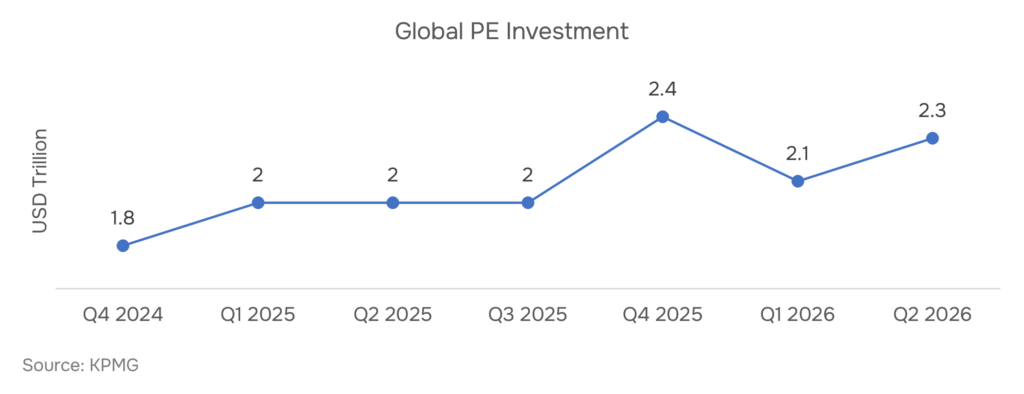
Despite this evidence, private equity entry multiples keep climbing. Average buyout entry multiples reached a record 11.8x EBITDA in 2025. For larger transactions above $500 million, multiples hit 18.1x EBITDA. Both are the highest levels on record.
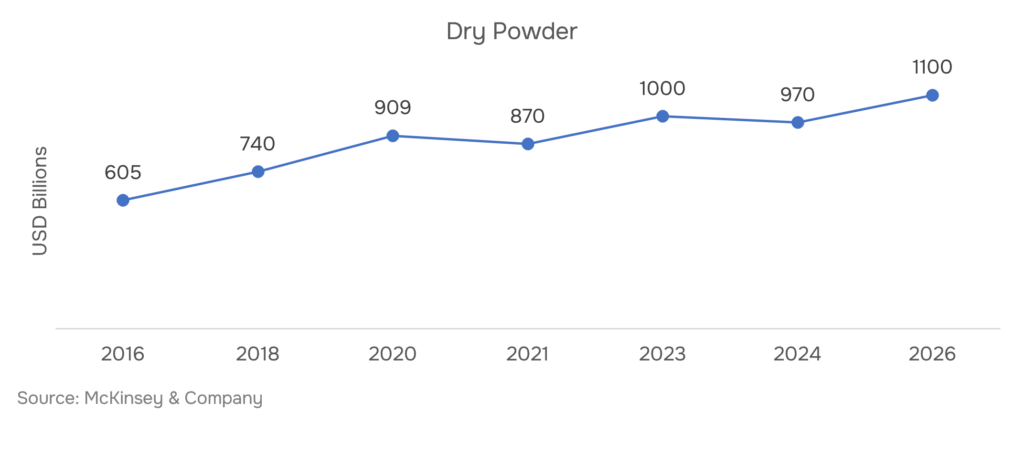
One major driver is capital sitting idle. Roughly 40% of available dry powder has gone unspent for two years or more, well above historical norms. As a result, managers face pressure to deploy capital at elevated prices instead of letting commitment periods lapse. This dry powder deployment pressure echoes the financing dynamics RCK Analytics examined in its blog on GP financing trends and what they signal for PE’s future.
However, sellers are recalibrating too. Several expected mid-tier and lower-quality companies never came to market in 2025 or were pulled from sale. The full report quantifies how much idle capital sits in vintages approaching the end of their investment periods.
At an average 11.8x EBITDA, and 18.1x for larger deals, the margin for error has shrunk. Buyers also rely less on leverage to amplify returns. The rate environment RCK Analytics tracked in its macroeconomic report on the Fed’s September 2026 rate decision reinforces that constraint by keeping financing costs elevated.
That shift shows up directly in what a deal needs to succeed. A buyout that needed 5% annual EBITDA growth a decade ago to reach a standard 2.5x return now needs roughly 12% annual growth. This EBITDA growth requirement means operational improvement must do most of the work that leverage and market tailwinds once did.
Few companies sustain that pace across a full holding period, a difficulty RCK Analytics explored in its blog on why most billion-dollar companies stall before reaching $10 billion. This suggests many assets acquired near the 2021–2022 pricing peak remain unsold today.
The full report breaks down how the required growth rate shifts across different entry multiple ranges.
For limited partners, purchase price discipline is becoming a checkable diligence signal. Entry multiples by fund, grouped by quartile, are now quantifiable and tied directly to realized returns. That removes much of the ambiguity that once made price discipline hard to verify before committing capital. This scrutiny connects to the trust dynamics RCK Analytics covered in its whitepaper on private equity’s liquidity crisis.
A senior economist at a leading global alternative asset manager reached a similar conclusion in published research. The research argued that easy money has ended, and that disciplined buying now creates outperformance rather than simple defense.
Firms navigating this shift can review RCK Analytics’ PE/VC Support service for portfolio value-creation and financial modeling support.
The full report outlines the entry-price diligence questions limited partners can now put to managers.
Disciplined buyers now generate 3.4x their money versus 2.7x for overpayers, a gap that barely existed a decade ago, even as record prices show most private equity firms aren’t adjusting.
No. Between 2010 and 2017, buyers in the cheapest purchase-price quartile earned 2.8x their invested capital versus 2.7x for the most expensive, a negligible gap, according to McKinsey’s September 2026 analysis. The gap widened only in the 2018–2023 vintage, when the cheapest quartile earned 3.4x versus 2.7x.
Average buyout entry multiples reached a record 11.8x EBITDA in 2025, and 18.1x for deals above $500 million, per McKinsey’s analysis. At those prices, with less leverage available, returns depend far more on operational growth, leaving little room for error if a portfolio company underperforms.
Roughly 12% annually, versus about 5% a decade ago, according to Bain & Company’s 2026 Midyear Private Equity Report. Higher entry prices and reduced leverage explain the change.
Sellers of several expected mid-tier and lower-quality companies withdrew them from sale or never launched processes in 2025, according to McKinsey’s analysis. This signals that pricing tension now runs in both directions, since buyers and sellers are both recalibrating expectations.
Share On




 info@rckanalytics.com
 +91 914 533 9262
 +91 (20) 46046669
 M 109 City Avenue, Shankar Kalat Nagar, Wakad, Pimpri-Chinchwad, Pune, Maharashtra, India - 411 057


Services
Sectors
Resources
Company
Copyright © 2026. RCK Analytics - All Rights Reserved.