


Whitepaper
5 min Read
17 Aug, 2026
Share On



This Whitepaper, part of our Private Equity series, covers why dealmaking stalled sharply in the first half of 2026 despite record dry powder, strong public markets, and available credit. Roughly 32,000 private equity-owned companies now sit unsold, and a record $121 billion moved through the secondary market in H1 2026 as fund managers increasingly sold assets to themselves rather than to outside buyers. However, the private equity liquidity crisis isn’t a capital shortage. It’s a breakdown in trust between fund managers and their investors, and that distinction changes what actually needs to happen next.
Private equity dealmaking stalled hard in the first half of 2026, even though nothing is fundamentally broken in the wider financial system. US software valuations fell 8.9% in early 2026, fund managers grew reluctant to sell aging companies at a discount, and roughly 32,000 portfolio companies now sit unsold across the industry.
Instead of real exits, a record $121 billion moved through the secondary market in H1 2026, much of it fund managers selling assets to themselves through continuation vehicles. This report breaks down why the industry is stuck, and what actually breaks the cycle.
Private equity firms started 2026 optimistic about a rebound in dealmaking. That optimism did not last. A string of shocks hit the industry at once. An AI-driven selloff hammered software valuations. Private lending markets faced new stress. Middle East conflict pushed oil prices higher. Together, these shocks pulled deal activity down hard in the first half of the year.
What makes this slowdown unusual is that nothing is actually broken underneath it. Public stock markets remain strong. Firms are sitting on massive uninvested cash reserves. This pattern echoes the selective, not broad-based, weakness RCK Analytics tracked in its recent manufacturing strength macroeconomic report. Instead, buying a company today costs more than ever. Purchase prices and financing costs combined now sit at record highs.
The full report identifies which specific deal segments face the most exposure if this cost pressure persists into 2027.
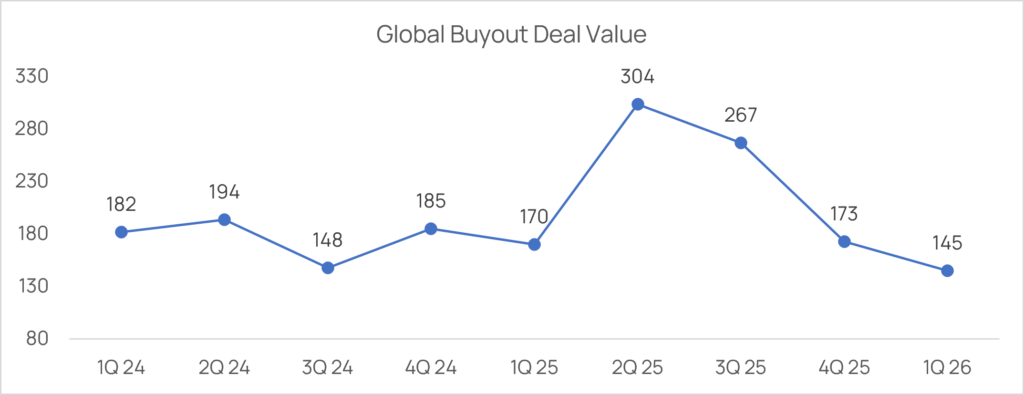
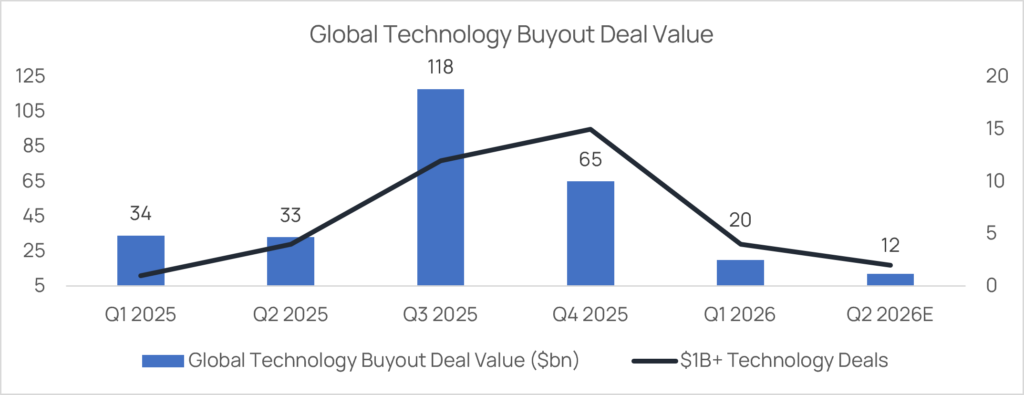
Technology and software deals took the biggest hit of any sector in early 2026. Total technology deal value fell 70% between Q4 2025 and Q1 2026. Buyers grew uncertain what software companies are actually worth. Artificial intelligence is reshaping the entire market. RCK Analytics examined this disruption directly in its whitepaper on how AI’s leverage, not its underlying thesis, unwound in July 2026.
The impact wasn’t evenly spread. US software valuations inside private equity portfolios fell 8.9% in Q1 2026 alone. That’s more than double Europe’s 4.2% decline. Meanwhile, public software stocks fell nearly 30% in February before partially recovering. This gap suggests private marks are still lagging what public markets already priced in. Firms tracking this exposure can review RCK Analytics’ TMT sector coverage for related valuation analysis.
The full report breaks down which software subsectors face the highest risk of further private markdowns through year-end.
At the center of private equity’s slowdown sits a genuine standoff. Investors want their cash back. Fund managers fear something specific: selling aging companies at a discount could damage their next fundraise. Most large investors lose confidence in a fund manager once a company sells for more than a 5% discount to its last reported value.
That fear pushes managers toward continuation vehicles instead. In this structure, a manager sells a company to a fund it also controls, rather than to an outside buyer. Use of these vehicles has roughly tripled over five years. Roughly 32,000 companies now sit unsold industry-wide. This dynamic connects directly to the financing pressures RCK Analytics flagged in its blog on GP financing trends and what they signal for PE’s future.
As a result, the secondary market hit a record $121 billion in H1 2026. Manager-led transactions grew faster than investor-led ones for the first time. The full report quantifies how much further continuation vehicle usage could climb before regulators or LPs push back harder.
Cash returned to investors sits at its lowest level in four years. The typical capital-return cycle has stretched to roughly seven years, well beyond historical norms. That drought explains why new fundraising has become difficult. Investors won’t commit fresh money until real cash comes back from existing investments first.
“We’re talking about a 5+ year problem, as the GFC was,” said Hugh MacArthur, Chair of Global Private Equity Practice at Bain & Company. He compared today’s slowdown to the aftermath of the 2008 financial crisis. Notably, a deal that needed just 5% profit growth a decade ago now needs roughly 12% to hit the same target return. Financial engineering alone no longer works. Firms navigating this shift can review RCK Analytics’ PE/VC Support service for portfolio value-creation and financial modeling support.
The full report outlines the specific operational levers that separate managers still raising capital quickly from those left behind.
Private equity isn’t short on cash it is stuck in a trust standoff. GPs won’t sell at a discount, LPs won’t commit new capital without cash back, and both sides are waiting.
Dealmaking has slowed because of a cost and confidence problem, not a capital shortage. The combination of high purchase prices and expensive financing has pushed private equity’s deal cost index to record levels, according to Bain & Company’s 2026 Midyear Report, while fund managers remain wary of selling assets at a valuation discount.
Yes. US software valuations inside private equity portfolios fell 8.9% in Q1 2026, more than double the 4.2% decline in Europe, per Bain’s analysis. Public software stocks fell nearly 30% over a similar window before partially recovering, suggesting private valuations may still have further to adjust.
Continuation vehicles let a fund manager sell a company to a new fund it also controls, creating an inherent conflict of interest since the manager sits on both sides of the transaction. Their use has roughly tripled since 2020, and growing reliance on them, rather than genuine third-party exits, is drawing increased scrutiny from limited partners, according to Forbes’ reporting on the trend.
There’s no confirmed date. Bain’s Global Private Equity Practice Chair has compared the current liquidity drought to the aftermath of the 2008 financial crisis, suggesting a multi-year recovery timeline rather than a near-term rebound, according to Bain & Company’s own commentary.
Share On




 info@rckanalytics.com
 +91 914 533 9262
 +91 (20) 46046669
 M 109 City Avenue, Shankar Kalat Nagar, Wakad, Pimpri-Chinchwad, Pune, Maharashtra, India - 411 057


Services
Sectors
Resources
Company