
Macroeconomy
5 min Read
18 Sep, 2026
Share On



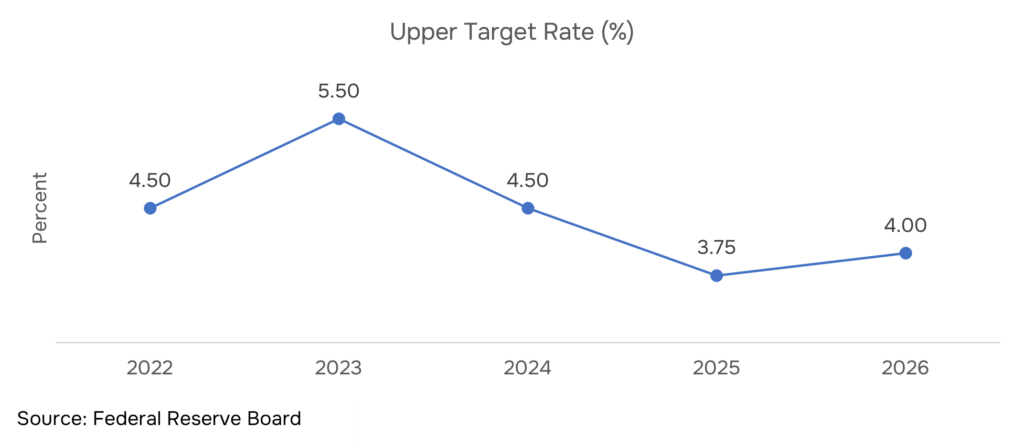
This week’s US macroeconomic report covers four decision-relevant developments between September 16 and September 17, 2026, following the Federal Reserve’s first-rate hike since July 2023. The FOMC voted 12-0 to raise rates to 3.75%-4.00%, while retail sales beat expectations sharply and the Philadelphia Fed’s manufacturing index cooled from a five-year high. Separately, Congress remained gridlocked on data center electricity costs. This extends the hawkish trajectory flagged across the Fed minutes and Jackson Hole reports of recent weeks.
Monetary Policy: The FOMC voted 12-0 to raise rates by 25 basis points to 3.75%-4.00%. Projections showed deep divisions over 2027 policy.Consumer Demand: August retail sales rebounded 1.2% to $773.9 billion. Control-group spending marked its strongest growth since late 2024.
Industrial Sector: The Philly Fed manufacturing index eased to 37.8, signaling cooling factory growth expectations.Legislative Gridlock: The Senate blocked the Ratepayer Protection Act. The block freezes data center energy rules until after the November midterms.
The Fed is fighting inflation. Consumers stay resilient while Congress remains gridlocked.
The Federal Open Market Committee voted 12-0 on September 16, 2026 to raise the federal funds rate by 25 basis points, to a target range of 3.75% to 4.00%, marking the first rate increase since July 2023. The unanimous vote followed a July meeting that saw three officials dissent in favor of a hike against a 9-3 majority to hold.
Consistent with Chair Kevin Warsh’s stated preference for minimal forward guidance, the post-meeting statement was brief, indicating future decisions would depend on incoming data. The Committee’s updated Summary of Economic Projections revealed continued division looking ahead to 2027: eight officials project at least one additional hike, six anticipate rates holding steady, and four project cuts.
The 30-year fixed mortgage rate had already climbed to 7.19% ahead of the decision, up roughly 38 basis points since Warsh’s Jackson Hole remarks, a dynamic RCK Analytics’ Investment Research team is tracking alongside the Fed minutes report from earlier this cycle.
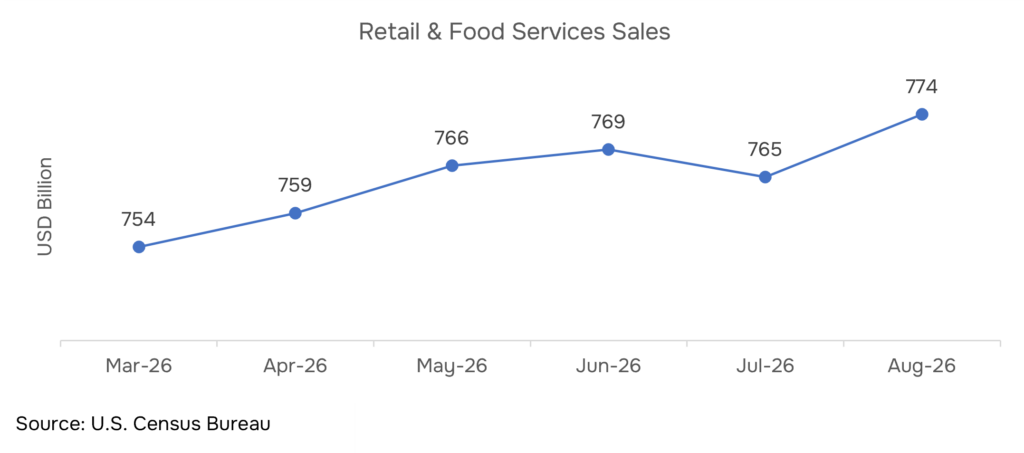
The U.S. Census Bureau reported on September 16, 2026 that retail and food services sales rose 1.2% month-over-month in August to $773.9 billion, significantly exceeding the 0.7% to 0.8% consensus forecast and reversing a revised 0.5% decline in July. Sales were 6.0% higher than August 2025.
Control group sales, which exclude the volatile gasoline, auto, and building materials categories, rose 1.4%, the strongest nominal gain since September 2024, with broad-based increases across miscellaneous store retailers, electronics and appliance stores, and health and personal care stores. Sales excluding gasoline still rose 1.1%, underscoring underlying consumer resilience beyond fuel-price effects.
Consequently, the result prompted several economists to raise third-quarter GDP growth estimates, landing one day ahead of the Federal Reserve’s rate decision. This resilience is a theme RCK Analytics’ FMCG sector coverage tracks closely alongside consumer spending patterns discussed in Markets Reprice Confidence Before Credit Risk.
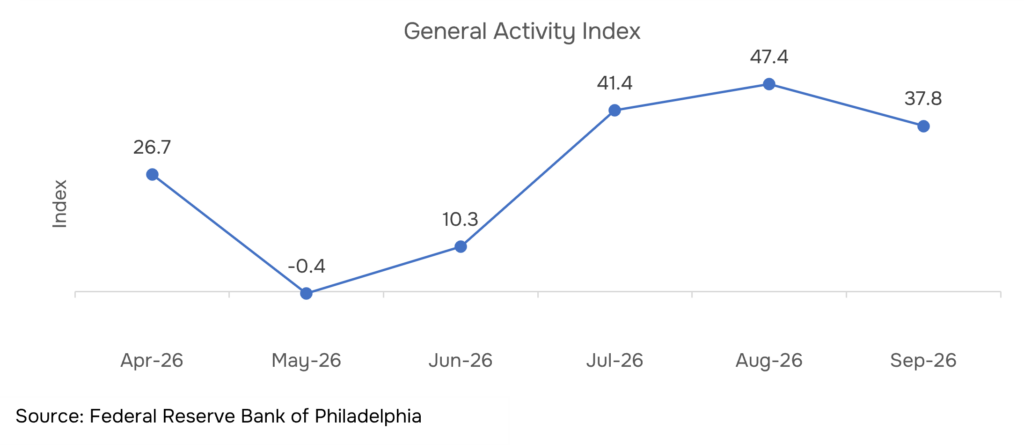
The Federal Reserve Bank of Philadelphia reported on September 17, 2026 that its Manufacturing Business Outlook Survey’s general activity index eased to 37.8 in September from 47.4 in August, a moderation that nonetheless beat the 30.5 to 31.3 consensus range. New orders held at 29.2 versus 30.1 in August, and shipments were unchanged at 27.7.
The employment index fell to 11.8 from 27.9, though it stayed in positive territory. Meanwhile, both price indexes moved higher: prices paid rose to 48.6 from 40.9, and prices received climbed to 31.3 from 17.7. The survey’s six-month outlook cooled more sharply, falling to 52.9 from 73.6.
This data arrived one day after the Federal Reserve’s rate decision, giving markets a first regional read on manufacturing sentiment under the new rate environment, relevant to RCK Analytics’ Manufacturing sector coverage and the capacity-planning themes explored in the AI Architecture Gap whitepaper.
The U.S. House of Representatives passed the Ratepayer Protection Act (H.R. 9340) by a 417-3 vote on September 16, 2026, legislation requiring state utility regulators to consider standards that would require large data centers to pay for associated electric grid infrastructure upgrades rather than passing those costs to consumers.
The following day, Senate Energy and Natural Resources Committee ranking member Martin Heinrich objected to Senator Jon Husted’s unanimous consent request to fast-track the bill, arguing the House version’s standards were voluntary rather than mandatory. Heinrich instead promoted his own alternative, the GRID Savings Act, which would grant the Federal Energy Regulatory Commission rulemaking authority over data center facilities demanding 150 megawatts or more of electricity.
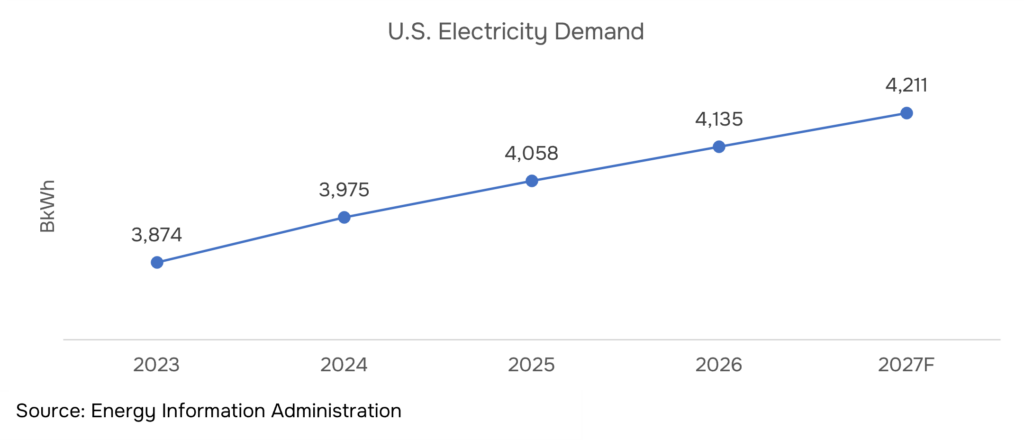
With the Senate scheduled to recess before the November 3 midterm election, the bill’s path to becoming law this year is effectively closed, a development relevant to RCK Analytics’ TMT sector coverage given continued data center-driven electricity demand cited in recent Federal Reserve regional surveys.
US growth is moderating while inflation stays sticky and energy risk builds, leaving an increasingly hawkish Federal Reserve confronting a labour market that is cooling faster than prices are falling.
The Federal Reserve’s September 16, 2026 hike to 3.75%-4.00% was its first rate increase since July 2023, following more than three years of holds and cuts. The unanimous 12-0 vote followed a July 2026 meeting where three officials had dissented in favor of a hike against a 9-3 majority to hold. (Source: Federal Reserve, FOMC Statement, September 16, 2026)
Yes, as September 2026 demonstrated: the Philadelphia Fed’s general activity index fell to 37.8 from August’s 47.4, a real month-over-month decline, yet still exceeded the 30.5 to 31.3 consensus range, since forecasters had expected an even sharper cooldown. (Source: Federal Reserve Bank of Philadelphia, Manufacturing Business Outlook Survey, September 2026)
Senator Martin Heinrich (D-NM), ranking member of the Senate Energy and Natural Resources Committee, objected to a unanimous consent request to fast-track the bill on September 17, 2026, arguing its cost-recovery standards for data centers were voluntary rather than mandatory. (Source: U.S. Congress, H.R. 9340 – Ratepayer Protection Act)
Not necessarily in isolation, but August 2026’s data supported it: retail sales rose 1.2%, well above consensus, reinforcing the “resilient” spending language in the Fed’s own September 16 statement, which cited solid economic activity as part of its justification for tightening. (Source: U.S. Census Bureau, Advance Monthly Retail Trade, August 2026)
Share On




 info@rckanalytics.com
 +91 914 533 9262
 +91 (20) 46046669
 M 109 City Avenue, Shankar Kalat Nagar, Wakad, Pimpri-Chinchwad, Pune, Maharashtra, India - 411 057


Services
Sectors
Resources
Company
Copyright © 2026. RCK Analytics - All Rights Reserved.