


Whitepaper
5 min Read
05 Oct, 2026
Share On



This Whitepaper, part of our Investment Research series with a BFSI sector focus, covers the Federal Reserve’s September 16, 2026 rate hike and what it means for bank and insurer profitability through year-end. The 10-year Treasury now trades near 5.26%, and official FDIC data already shows the strain: industry net interest margin fell from 3.39% in Q4 2025 to 3.31% in Q1 2026. However, rising rates are not a single story across BFSI. Insurers broadly benefit from higher reinvestment yields, while banks face a genuine trade-off between stronger asset yields and falling bond portfolio values, a split this report breaks down in detail.
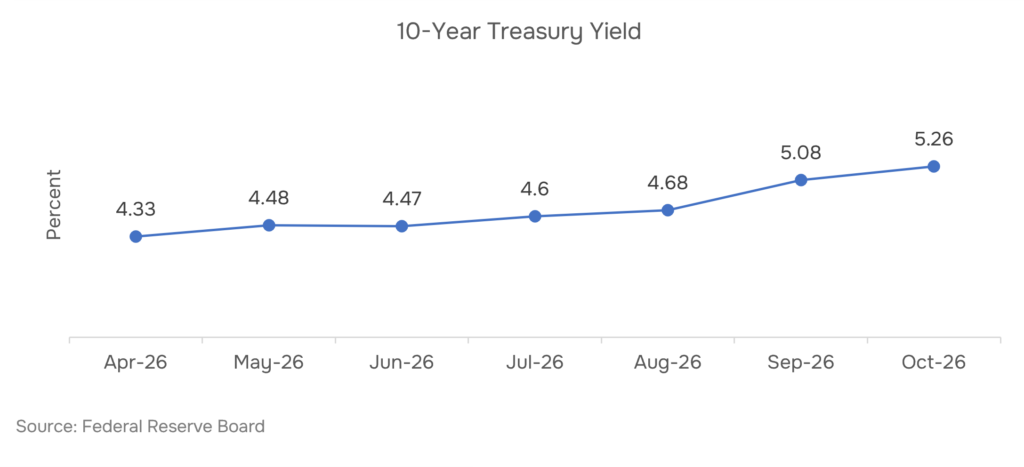
On September 16, 2026, the Federal Reserve raised its benchmark rate to 3.75%-4.00%, its first hike in over three years, with one more signaled before year-end. Treasury yields have risen in response, with the 10-year near 5.02%, as new bonds carry higher coupons while existing, fixed-coupon bonds reprice lower to match.
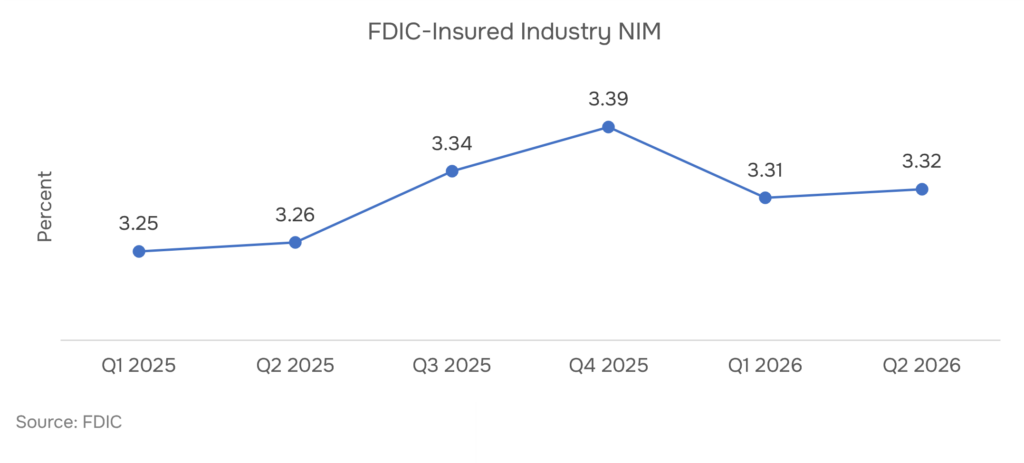
Official FDIC data shows the strain already building: industry net interest margin fell from 3.39% in Q4 2025 to 3.31% in Q1 2026, before only marginal recovery to 3.32% in Q2, even as aggregate bank net income reached $80.5 billion. The impact splits by business model: insurers broadly benefit from higher reinvestment yields, while banks face a genuine trade-off between rising asset yields and falling bond portfolio values.
On September 16, 2026, the Federal Reserve raised its benchmark rate 25 basis points to a range of 3.75% to 4.00%, its first hike in more than three years, approved unanimously. The Fed’s dot plot signals one more hike before year-end, a policy shift RCK Analytics tracked directly in its macroeconomic report on the Fed’s September rate decision.
Treasury yields are rising through two connected channels. New bonds carry higher coupons to match today’s rates. Existing bonds, with coupons fixed at issuance, instead reprice lower in the secondary market, producing a higher effective yield without any change to the original coupon, a dynamic RCK Analytics examined in its blog on why long bond yields are near 2007 levels.
Investors are demanding that higher yield largely due to oil-linked inflation, pushing the 10-year Treasury near 5.26%.The full report breaks down how this repricing mechanism is already showing up in bank and insurer balance sheets.
Most BFSI 2026 planning assumed the opposite of what happened. Earlier sector forecasts expected short-term yields to decline this year, with net interest income growth staying modest. Instead, official FDIC data confirms margin pressure was already building before the Fed’s reversal.
Industry-wide net interest margin fell from 3.39% in Q4 2025 to 3.31% in Q1 2026, as earning-asset yields fell faster than funding costs could adjust. By Q2, margin had only marginally recovered to 3.32%. This dynamic sits alongside the foreign demand shifts RCK Analytics tracked in its blog on what TIC data reveals about foreign Treasury demand, relevant to the BFSI sector broadly.
Despite the pressure, aggregate performance remained resilient: Q1 2026 net income across FDIC-insured institutions reached $80.5 billion, a return on assets of 1.26%. The full report quantifies how much further margin could compress if the Fed delivers its signaled year-end hike.
Rising rates create a genuine three-way trade-off across BFSI: stronger asset yields, costlier funding, and weaker bond valuations, and which force dominates determines performance. This volatility backdrop connects to the seasonal risk factors RCK Analytics outlined in its whitepaper on the September 2026 market seasonality setup.
For insurers, the balance tilts favorably: higher yields boost investment income as maturing bonds roll into higher-yielding replacements. However, insurers also face higher financing costs, and previously purchased lower-yield bonds become comparatively less attractive to hold.
For banks, the trade-off runs in multiple directions at once. Interest income on new loans rises, but banks must offer higher deposit rates to stay competitive, while rising long-term yields reduce the market value of existing bond holdings. A bank funded mainly by low-cost, stable deposits and floating-rate loans benefits more than one dependent on wholesale funding.
The full report identifies which bank balance sheet structures are best positioned for a further year-end hike.
Net interest margin, calculated as interest income minus interest expense divided by average earning assets, is the clearest real-time signal of which institutions benefit from this rate environment, independent of the Fed’s headline rate itself.
Rising Treasury yields also raise the bar for riskier assets. Investors increasingly demand a higher risk premium for equities, since safer government bonds now offer a meaningfully higher baseline return. Firms modeling this shift across portfolios can review RCK Analytics’ Financial Modeling service.
The institutions best positioned through year-end combine expanding margin with a low-cost, stable deposit base and predominantly floating-rate loan books, a specific, trackable combination rather than a sector-wide assumption.
The full report outlines the exact margin and funding-mix thresholds that separate the two outcomes.
The Fed’s first rate hike in three years is reshaping BFSI profitability through a three-way trade-off: stronger asset yields, costlier funding, and falling bond valuations, with winners and losers determined by balance sheet structure, not sector membership.
The Federal Reserve raised its benchmark rate 25 basis points to a range of 3.75% to 4.00%, its first hike in more than three years, in a unanimous vote, according to CNBC’s coverage of the decision. The Fed’s dot plot signals one additional hike before year-end.
Yields are rising because new bonds carry higher coupons to match current rates, while existing bonds with fixed coupons reprice lower in the secondary market to produce a comparable yield, according to U.S. Bank’s analysis of the 2026 bond market. Oil-linked inflation expectations are a key driver of the move.
Not entirely. Rising rates are broadly positive for insurers because they boost investment income and improve reinvestment economics, but the same conditions also raise financing costs and make previously purchased lower-yield bonds comparatively less attractive, according to the National Association of Insurance Commissioners’ analysis.
The risk is significant. Industry net interest margin fell from 3.39% in Q4 2025 to 3.31% in Q1 2026 before only marginal recovery, according to FDIC’s Quarterly Banking Profile. Banks dependent on wholesale or rate-sensitive funding can see margins compress even as the broader industry average holds steady.
Share On




 info@rckanalytics.com
 +91 914 533 9262
 +91 (20) 46046669
 M 109 City Avenue, Shankar Kalat Nagar, Wakad, Pimpri-Chinchwad, Pune, Maharashtra, India - 411 057


Services
Sectors
Resources
Company
Copyright © 2026. RCK Analytics - All Rights Reserved.