
Whitepaper
5 min Read
19 Oct, 2026
Share On



This Whitepaper, part of our Investment Research and Manufacturing sector series, covers the US manufacturing outlook for October 2026. Three forces now shape returns. Agentic AI is reaching supply chains. Deal value hit a record $173 billion over the trailing twelve months. The semiconductor cycle is forecast at $1.5 trillion in 2026. The manufacturing PMI of 54.5 confirms expansion. However, a prices index of 77.9 shows costs rising alongside demand. Strategic buyers drive 86% of deal value. Meanwhile, a 35% chip tax credit requires construction starts before January 1, 2027. The central question is which assets convert this demand into durable returns.
The US manufacturing outlook is defined by autonomy, scale, and silicon. Supply chain software with agentic AI is forecast to reach $53 billion by 2030, up from under $2 billion in 2025. However, adoption remains early. Deal value reached a record $173 billion over the trailing twelve months, with strategic buyers driving 86%.
Global semiconductor sales are projected to reach $1.5 trillion in 2026. Meanwhile, a 54.5 PMI coexists with a 77.9 prices index, so cost pressure is building. A 35% chip credit requires construction starts before January 1, 2027.
Geopolitical shocks and trade-policy shifts keep testing supply chains across the Manufacturing sector. In response, manufacturers are moving from dashboards toward autonomous orchestration. Agentic AI systems are designed to scan global trade data and flag a disruption early. They also evaluate alternative suppliers before planners log the delay. Early warning matters because a delayed part can idle an assembly line.
Spending reflects that ambition. Agentic supply chain software spend is forecast to reach $53 billion by 2030, up from under $2 billion in 2025. That pace shows manufacturers want tools that execute decisions, not just recommend them. However, adoption remains early.
Only 5% of enterprises using supply chain software had adopted agentic features in 2025. The forecast reaches 60% by 2030. A separate outlook projects half of cross-functional supply chain solutions will use agents to autonomously execute decisions by 2030. Meanwhile, deployment will lag availability, because data management, operations, and workforce readiness must mature first.
The full report details when analysts expect multi-step agent workflows and what that means for target selection.
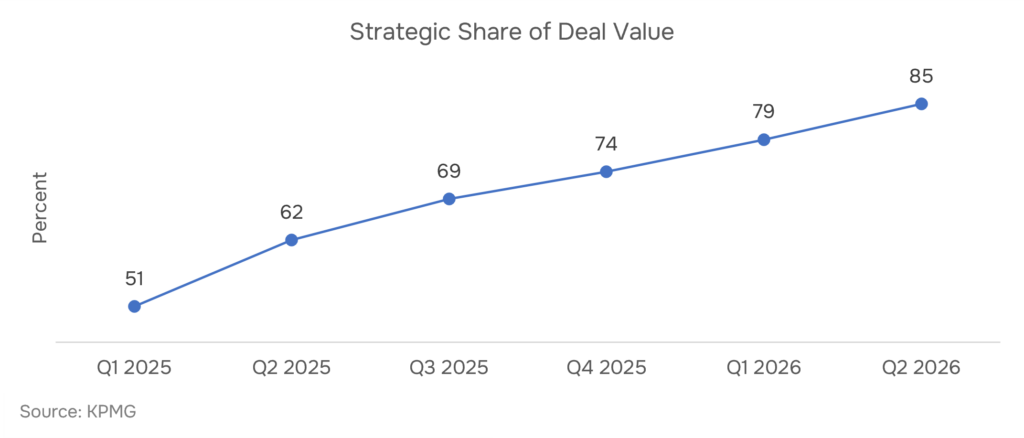
Industrial manufacturing M&A reached a record $173 billion over the trailing twelve months reported in mid-2026. That total is up 28% from $135 billion in the prior fiscal year. Notably, strategic corporate buyers accounted for 86% of the deal value. In addition, transactions above $5 billion made up 56%, up from 18% in fiscal 2024.
Cross-border buyers represented 56% of deal value, up from 30% in fiscal 2022. Meanwhile, US-targeted deal value nearly doubled to $72 billion in fiscal 2025. AI data center hardware, grid resilience, and defense-linked supply chains drive the activity. As a result, the highest valuations sit in power equipment, thermal management, automation and controls, and advanced components. Buyers are paying for strategic control rather than volume.
A $22.6 billion industrial software acquisition announced October 5, 2026 is the acquirer’s largest ever. It also fits the scale-over-volume dynamic RCK Analytics tracked in its blog on H1 2026 mega-deals. Therefore, banks and sponsors mapping these mandates can draw on RCK Analytics’ Investment Banking team.
The full report profiles three more recent transactions and the portfolio separation trend among industrial conglomerates.
Semiconductors anchor the subsector’s growth. Global chip sales reached a record $795.6 billion in 2025. Notably, they are projected to reach $1.5 trillion in 2026, nearly double the prior year. Second-quarter 2026 sales hit $403.3 billion, up 35.1% from the first quarter.
Demand has a deep pipeline. Government and industry are expected to invest more than $4 trillion in AI data center infrastructure through 2028. Up to $2.8 trillion of that is directed to semiconductors. RCK Analytics covered this financing wave in its blog on AI infrastructure financing and how a $500 billion deal formed. Meanwhile, US semiconductor firms invested a record $76.8 billion in research and development in 2025. They also hold a 53.4% global share of sales.
Public capital has pulled capacity forward. CHIPS Act incentives total $52.7 billion in appropriations, and the government has awarded more than $33 billion directly. As a result, announced private investment exceeds $770 billion across 160 projects in 30 states. Because fabrication takes years to build, these awards anchor supplier ecosystems.
The full report explains how the 35% credit deadline changes underwriting and why memory pricing complicates growth.
The US manufacturing PMI registered 54.5 in September 2026, its ninth consecutive month of expansion. That reading is historically consistent with roughly 2.4% annualized real GDP growth. New orders rose to 55.3. Employment reached 52.7, a third straight expansionary reading after a 33-month contraction streak.
However, the prices index climbed to 77.9 from 71.1, so cost pressure is building as demand strengthens. That pressure echoes the inflation signals RCK Analytics tracked in its macroeconomic report on accelerating CPI and PPI. It also mirrors the tariff-driven input dynamics in its whitepaper on copper’s rally and tariff stockpiling. Margin resilience therefore matters as much as order growth.
Capital is following demand into assets with pricing power. Strategic buyers drive 86% of deal value, and mega-transactions account for 56%. The richest valuations cluster in power, thermal management, and automation. In addition, a 35% chip tax credit requires construction starts before January 1, 2027, which compresses timelines.
The full report names the three variables that will shape the next two quarters and the exposures they favor.
US manufacturing is expanding on strategic capital: $173 billion of trailing M&A, a $1.5 trillion chip cycle, and early agentic supply chains, while rising costs and policy deadlines decide which returns last.
The forecasts are steep, but they are projections. Gartner’s 2026 forecast puts spending on supply chain software with agentic AI at $53 billion by 2030, up from under $2 billion in 2025, with 60% of enterprises using such software adopting agentic features. Deployment lags availability because data, operations, and workforce readiness must mature first.
No. The manufacturing PMI registered 54.5 in September 2026, but its prices index rose to 77.9 from 71.1, according to the ISM September 2026 report. Expanding orders can still pressure margins when input costs climb faster than selling prices.
Yes, if construction begins before January 1, 2027. The advanced manufacturing credit rose from 25% to 35% for property placed in service after December 31, 2025, according to Manufacturing Magazine’s analysis of the deadline. Policy dates like this now act as valuation catalysts, a theme RCK Analytics covered in its whitepaper on healthcare policy deadlines and drug valuations.
Global semiconductor sales are projected to exceed $1.5 trillion in 2026. Second-quarter sales alone reached $403.3 billion, up 35.1% from the first quarter, according to the Semiconductor Industry Association.
Share On




 info@rckanalytics.com
 +91 914 533 9262
 +91 (20) 46046669
 M 109 City Avenue, Shankar Kalat Nagar, Wakad, Pimpri-Chinchwad, Pune, Maharashtra, India - 411 057


Services
Sectors
Resources
Company
Copyright © 2026. RCK Analytics - All Rights Reserved.