
Whitepaper
6 min Read
16 Nov, 2026
Share On


The FMCG industry outlook for U.S. consumer staples turns on which brands earn spending once price stops driving growth. This weekly RCK Analytics whitepaper series examines how polarized demand, rising store-brand share and selective acquisitions reshape the FMCG sector. NielsenIQ places this divide within a U.S. consumer goods market above $1.1 trillion. Bankers, sponsors, investor-relations teams and strategists must decide where to underwrite growth and what to pay for category access. However, dollar spending rises while unit demand falls, so capital favors brands and capabilities with defensible positions. The central tension is clear: functional nutrition offers visible growth, but profitability depends on execution rather than price.
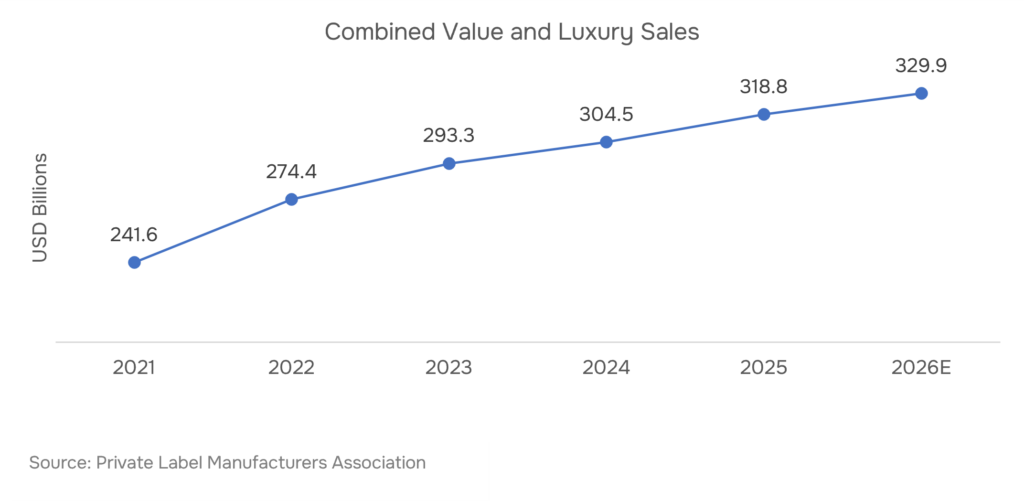
The FMCG industry outlook is shifting from price-led growth to a contest for consumer relevance, share and margin resilience. August spending rose 0.8% year over year while unit demand fell 1.7%, and store brands reached 23.5% of retail unit sales through August 9. U.S. food and beverage deal activity rebounded 18.8% sequentially in Q3, led by strategic buyers pursuing brands, distribution and specialty capabilities. Functional snacks generated $19 billion in sales, up 12.7%, with high-protein products at $12.1 billion. USDA forecasts overall food-price inflation of 1.7% in 2027, so profitable growth will depend on innovation, productivity, valuation discipline and repeat demand.
Shoppers are splitting between premium products with distinct benefits and lower-priced alternatives, according to NielsenIQ, across a U.S. consumer goods market above $1.1 trillion. As a result, mainstream brands face exposure when differentiation cannot justify a price premium. Investors following consumer staples can review RCK Analytics’ FMCG sector research for related coverage.
August 2026 retail spending rose 0.8% year over year; however, unit demand fell 1.7%. Food and beverage sales increased just 0.2% in the four weeks ending August 29, while units declined 1.8%. Dollar growth therefore obscures brand momentum. Meanwhile, the weekly macro report flags retail sales losing momentum as price indices accelerate.
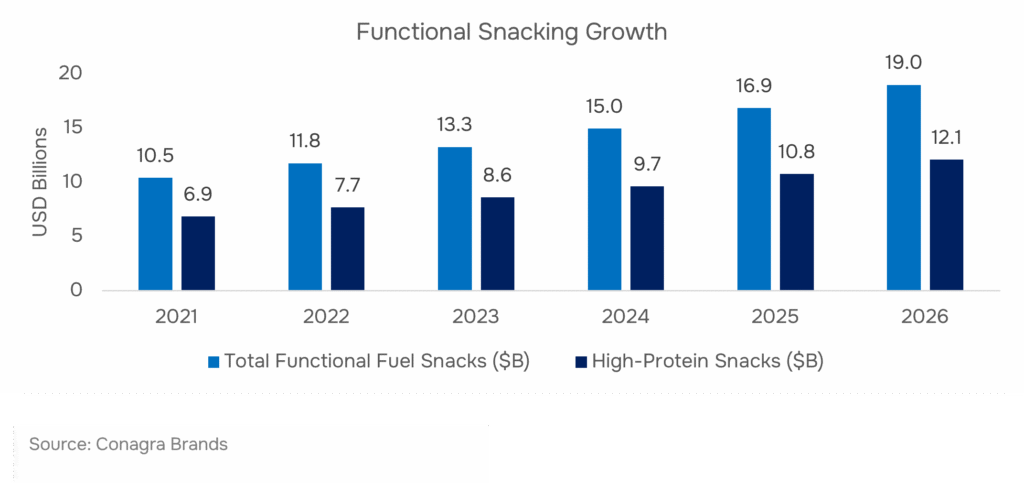
Private labels add pressure. Store brands reached 23.5% of U.S. retail unit sales over the eight months ending August 9, an all-time high. Their units rose 0.3%, while national-brand units declined 0.7%. Because private label penetration is rising, retailers hold stronger negotiating leverage, so branded manufacturers need demonstrable superiority, disciplined price-pack architecture and sharper innovation.
The full report also contrasts this demand split with functional snacking’s 12.7% growth.
U.S. food and beverage M&A rebounded in Q3 2026, with 76 transactions versus 64 in Q2, an 18.8% sequential increase. Strategic deals rose from 55 to 66. In addition, the rebound reflects renewed execution, not indiscriminate risk-taking.
Hormel Foods agreed on September 30 to acquire Brakebush Brothers for approximately $1.055 billion, expanding value-added chicken and foodservice reach. Intersnack agreed in July to take Utz Brands private at an approximately $2.9 billion enterprise value. The 91% premium to its July 20 price shows the value assigned to established brands and distribution.
Keurig Dr Pepper acquired 97.75% of JDE Peet’s by April 15, paying approximately $17.4 billion for tendered shares. Ingredion’s June 8 recommended all-cash offer values Tate & Lyle at approximately $5 billion in enterprise value. Notably, its 59% premium underlines the importance of texture, sweetening, sugar reduction and fortification. For acquirers, valuation discipline remains essential; see RCK Analytics’ whitepaper on why purchase price discipline determines private equity returns.
The full report also details Keurig Dr Pepper’s $925 million Chobani exit and Hain Celestial’s debt-focused sale.
Functional snacking growth is a scaled opportunity in U.S. food and beverage. Products positioned around protein, energy, digestion and hydration generated $19 billion in retail sales, up 12.7% year over year. High-protein snacks represented $12.1 billion, so nutrition-led propositions have moved beyond a niche.
The opportunity sits within a $198.2 billion U.S. snacking market, where consumers expect taste, convenience and a benefit. Demand now extends beyond protein bars into products combining protein, fiber, probiotics or hydration. However, claims must be credible and supported by repeat purchasing, not launch-driven trial alone. Diligence should therefore test whether growth converts into sustainable margins and whether retention supports lifetime value.
For private equity, attractive platforms combine brand recognition with defensible formulations, retailer relationships and efficient manufacturing. Add-on acquisitions can broaden formats and improve scale economics. Strategic buyers may value such assets for category entry or innovation pipelines. Teams screening consumer platforms and add-ons can use RCK Analytics’ private equity and venture capital support team.
The full report also compares USDA’s 2026 and 2027 food-at-home and food-away-from-home price forecasts.
USDA’s October 2026 outlook points to slower food-price growth, not a volume rebound. It forecasts overall food prices rising 2.8% in 2026 and 1.7% in 2027. Food-at-home inflation is forecast at 2.3% and 1.0%, while food-away-from-home prices are projected to rise 3.5% and 2.8%. These are price forecasts, not sales or unit-volume forecasts.
Margin resilience will depend on procurement, productivity and price-pack execution. Input costs move with commodities, energy, packaging, freight and trade policy. Manufacturers may struggle to pass increases through as shoppers trade down and private labels expand. Investors should monitor gross-margin recovery, promotional intensity, inventory turns, working capital and the dollar-to-unit growth gap.
Protein and functional ingredients can support premium positioning when taste, efficacy and repeat purchase are established. Digital commerce and AI-enabled forecasting, pricing, inventory and marketing offer productivity opportunities when they improve service, waste, conversion or cost-to-serve. Readers testing AI productivity claims can review RCK Analytics’ blog on companies still unable to show AI’s EBITDA impact. Teams stress-testing margin drivers can use RCK Analytics’ financial modeling team.
The full report also compares the 91% Utz premium with the 59% Tate & Lyle premium.
In this FMCG industry outlook, businesses that defend relevance, protect margins, allocate capital selectively and convert innovation into repeat purchases are positioned for sustainable growth.
USDA forecasts overall food prices rising 1.7% in 2027, after 2.8% in 2026, according to USDA Economic Research Service. Food-at-home prices are forecast to rise 1.0% and food-away-from-home prices 2.8% in 2027. These are price forecasts, not unit-volume forecasts.
Intersnack offered a 91% premium to Utz’s July 20 closing price, valuing the company at an enterprise value of approximately $2.9 billion, according to Utz Brands’ announcement. The July agreement gives Intersnack a U.S. salty-snacks platform. The premium shows the value assigned to established brands and distribution.
The main risk is financing: Hain Celestial’s approximately $323 million international sale depends on a lender amendment, according to Hain Celestial’s SEC filing. By November 9, regulatory approval was secured, but the amendment was not obtained by October 12 and discussions continued. Expected net proceeds of $305 million to $310 million are intended for debt reduction.
Store brands are, with unit sales up 0.3% against a 0.7% decline for national brands over the eight months ending August 9. Store brands held 23.5% of U.S. retail unit sales over that period, an all-time high. According to PLMA, store brands also outperformed national brands on unit sales through the third quarter.
Download the full report to see Keurig Dr Pepper and Hain Celestial’s asset exits, USDA’s 2026 and 2027 price forecasts by category and the functional snacking sales split.
Share On



 info@rckanalytics.com
 +91 914 533 9262
 +91 (20) 46046669
 M 109 City Avenue, Shankar Kalat Nagar, Wakad, Pimpri-Chinchwad, Pune, Maharashtra, India - 411 057


Services
Sectors
Resources
Company
Copyright © 2026. RCK Analytics - All Rights Reserved.